:root{
–accent:#f0c419;
–accent-dark:#d1aa14;
–dark:#1f2329;
–text:#3e4349;
–muted:#f6f6f4;
–border:#e7e7e2;
–white:#ffffff;
}
*{box-sizing:border-box}
body{margin:0;font-family:Arial,Helvetica,sans-serif;color:var(–text);line-height:1.65;background:#ffffff}
img{max-width:100%;display:block;border-radius:20px}
a{color:#111111;text-decoration:none;border-bottom:1px solid rgba(17,17,17,.22)}
h1,h2,h3{color:#22262b;line-height:1.2;margin:0 0 14px}
p{margin:0 0 16px}
ul,ol{margin:0 0 18px 22px}
li{margin-bottom:10px}
section{padding:52px 20px}
.container{max-width:1180px;margin:0 auto}
.hero{background:linear-gradient(126deg,var(–dark) 0%,var(–dark) 57%,var(–accent) 57%,var(–accent) 100%);color:#ffffff}
.hero h1,.hero h2,.hero h3,.hero p,.hero li{color:#ffffff}
.hero-grid,.split,.cta-grid,.contact-grid,.article-grid{display:grid;grid-template-columns:1.08fr .92fr;gap:34px;align-items:center}
.eyebrow{display:inline-block;margin-bottom:14px;font-size:12px;letter-spacing:.18em;text-transform:uppercase;font-weight:700;color:rgba(255,255,255,.78)}
.hero .eyebrow{color:rgba(255,255,255,.78)}
.section-eyebrow{display:inline-block;margin-bottom:12px;font-size:12px;letter-spacing:.16em;text-transform:uppercase;font-weight:700;color:#767b82}
.lead{font-size:18px;max-width:760px}
.button-row{display:flex;flex-wrap:wrap;gap:12px;margin-top:22px}
.button{display:inline-block;padding:14px 22px;border-radius:999px;background:var(–accent);color:#111111;font-weight:700;border:none}
.button.alt{background:transparent;color:#ffffff;border:1px solid rgba(255,255,255,.34)}
.button.dark{background:#111111;color:#ffffff}
.button.light{background:#ffffff;color:#111111}
.section-light{background:var(–muted)}
.cards{display:grid;grid-template-columns:repeat(auto-fit,minmax(220px,1fr));gap:18px}
.card{background:#ffffff;border:1px solid var(–border);border-radius:22px;padding:24px;box-shadow:0 12px 24px rgba(17,17,17,.04)}
.card h3{font-size:22px}
.card p:last-child{margin-bottom:0}
.image-frame{overflow:hidden;border-radius:22px;box-shadow:0 18px 34px rgba(17,17,17,.10)}
.band{background:linear-gradient(126deg,var(–accent) 0%,var(–accent) 58%,var(–dark) 58%,var(–dark) 100%)}
.band h2,.band h3,.band p,.band li{color:#ffffff}
.band-cards{display:grid;grid-template-columns:repeat(auto-fit,minmax(220px,1fr));gap:16px;margin-top:20px}
.band-card{padding:20px;border:1px solid rgba(255,255,255,.18);border-radius:20px;background:rgba(255,255,255,.08)}
.faq{max-width:980px}
.faq-item{padding:18px 0;border-top:1px solid var(–border)}
.faq-item:last-child{border-bottom:1px solid var(–border)}
.checklist{padding-left:18px}
.gallery{display:grid;grid-template-columns:repeat(auto-fit,minmax(240px,1fr));gap:18px}
.note{background:#fff7d6;border-left:4px solid var(–accent-dark);padding:18px;border-radius:14px}
.compare-table{width:100%;border-collapse:collapse;background:#ffffff;border-radius:18px;overflow:hidden}
.compare-table th,.compare-table td{padding:14px 16px;border:1px solid var(–border);vertical-align:top;text-align:left}
.compare-table th{background:#fbfbf8}
.pill-grid{display:flex;flex-wrap:wrap;gap:10px}
.pill{display:inline-block;padding:10px 14px;border-radius:999px;background:#ffffff;border:1px solid var(–border);font-weight:700}
.form-shell{background:#ffffff;border:1px solid var(–border);border-radius:22px;padding:24px;box-shadow:0 12px 24px rgba(17,17,17,.04)}
.field{display:flex;flex-direction:column;gap:8px;margin-bottom:14px}
.field input,.field textarea,.field select{width:100%;padding:14px 16px;border:1px solid #d7d9dd;border-radius:14px;font:inherit}
.field textarea{min-height:140px;resize:vertical}
.two-col{display:grid;grid-template-columns:repeat(2,minmax(0,1fr));gap:14px}
.cta-panel{background:#ffffff;border-radius:22px;padding:28px;border:1px solid var(–border);box-shadow:0 14px 28px rgba(17,17,17,.05)}
.small{font-size:14px;color:#666c73}
.article h2{margin-top:0}
.article-section{margin-bottom:34px}
.muted-box{background:#f8f8f6;border:1px solid var(–border);border-radius:20px;padding:20px}
@media (max-width: 900px){
.hero-grid,.split,.cta-grid,.contact-grid,.article-grid,.two-col{grid-template-columns:1fr}
section{padding:42px 16px}
.lead{font-size:17px}
}
Canopy Tent Banner Sizes Explained
Canopy tent banner sizes are easiest to understand when you start with placement, viewing distance, and the size of the tent rather than searching for one universal answer. A banner only works when the finished display still feels readable and balanced.
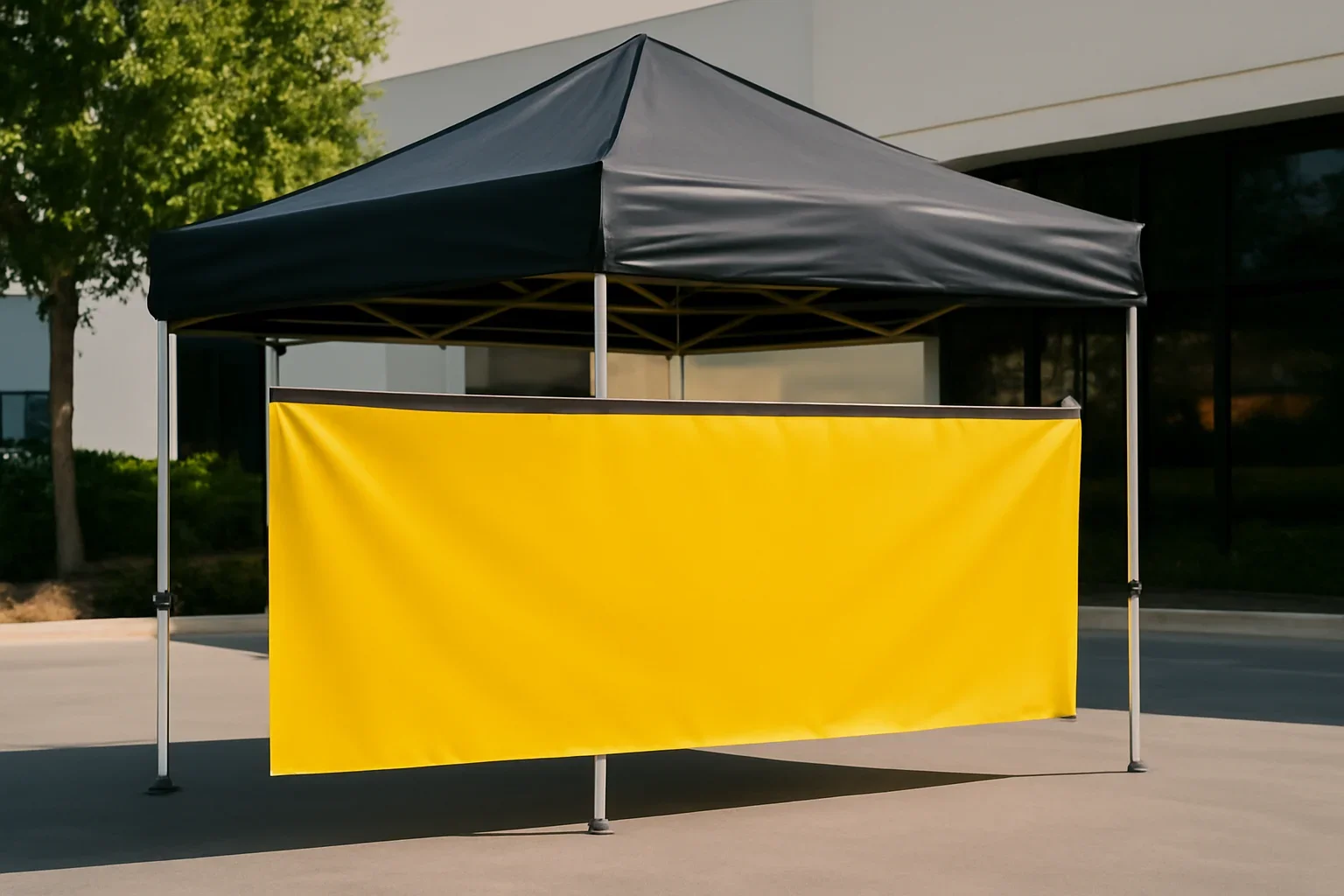
Practical takeaways on canopy tent banner sizes explained
Buyers often ask for the normal banner size, but a more useful question is what the banner needs to do. The right size for a quick brand identifier is not always the same as the right size for a menu, sponsor display, or directional message.
Think about where the banner will be seen from
A front-facing banner meant to catch attention from across a lane needs a different design approach than a graphic intended for close-up reading. Distance changes what size feels effective.
That is why message length and banner size should be considered together.
Match the banner to the tent footprint
A banner should look like part of the canopy system, not like a separate piece that happened to be attached later. The tent size sets the visual stage for what will feel proportionate.
This is one reason templates and proofs are so helpful.
- Confirm the tent size before finalizing the banner art
- Check hardware placement and edge allowances
- Keep the banner message simpler than you think you need
Use the banner to support the full booth, not compete with it
The roofline, valances, walls, and front banner all share the same visual job. When every piece tries to say too much, the booth gets harder to understand.
The strongest setups give each surface a clear role.
Proofing catches banner issues early
A banner can look fine on its own artboard and still feel awkward once attached to the canopy. Reviewing the proof in context is where spacing, readability, and visual balance become much clearer.
That step is worth slowing down for.

Bring the article back to the real buying decision
The most useful canopy advice is the advice that changes what you do next. Once the sizing, setup, or accessory direction is clearer, the buying path becomes much easier to manage.
You can keep researching in the blog, compare related products such as commercial canopies and custom canopy tents, or reach out through contact with the project details.
- Use the article to narrow the decision, not delay it
- Match the tent to the real layout and setup conditions
- Treat branding, walls, banners, and weights as part of the full package
Quick questions about canopy tent banner sizes explained
These answers cover the questions that usually come up right after the main comparison or planning points.
Is there one standard banner size for every tent?
No. The tent size, hardware, and purpose of the banner all change the answer.
Should banner text match the canopy roof exactly?
Not always. The banner may work better as a supporting message or quick identifier.
Why do templates matter for banners?
They show the real usable area and help prevent proportion problems.
Need help applying this advice to your own canopy order?
Tell us what kind of setup you are planning, whether the canopy needs custom branding, and which part of the decision still feels unclear. We will help you move from general research to a practical next step.
- Mention the tent size or size range you are considering
- Share the event, market, team, or promotional use case
- Include notes on graphics, walls, banners, weights, or timing